It was built for an exhibition, organised by Eberhard Blum, to celebrate the inventor of the modern flute, Theobald Boehm, at the Künstlerhaus Bethanien Berlin, in 1980. The dimensions of the flute are based on Boehm's recommendations.
Detail of the specially-made alto flute with its 12 electomagnetic keys and the embouchure.
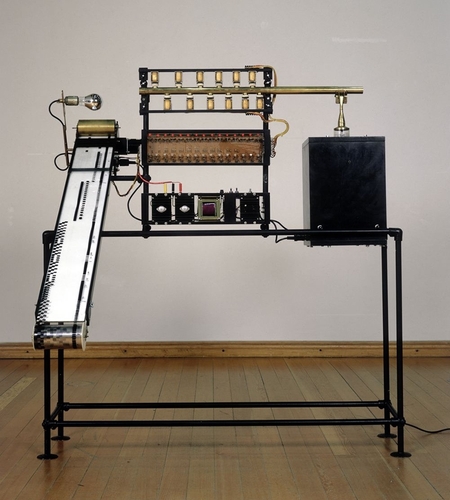
A specially made alto flute programmed by felt-tip pen markings on a transparent music roll.
A row of 15 photo cells read the music roll and their amplified signals operate the 12 keys
of the flute and the valve which controls the flow of air from the blower into the mouth
piece of the flute. The markings on the music roll can be seen by the audience before they are played.
The Flute-playing Machine(1979-82)
Alto flute, range g to g', blower, electro-magnets, electronics.150cm high.
On the right is the blower encased in its soundproof black box. The design of the sound-proofing was based on advice from Stephan von Huene. On top of the blower is a valve that admits the air into the mouth piece of the flute. The horizontal brass tube is an especially made alto flute with a range of g to g'. It is fitted with 12 electro-magnetic valves. The diagonal slide on the left guides the music roll over a row of 15 photocells. Their signals are amplified by circuitry in the box below the flute and operate the valves and the air valve. The positions and sizes of the holes for the valves were based on the formulas published by Theobald Boehm plus some experiments with a prototype flute fitted with "sliding holes":
The valves of a Boehm flute are normally open and are closed by the fingers of the player, assisted by mechanisms to close several widely-spaced valves. Each valve on the machine is normally held closed by a spring. A single track on the music roll opens the valve for that note and for the three valves immediately above it, which, so I discovered, is sufficient to play a good clear note but with minimal mechanical noise from the valves. The circuitry, with its Schmitt triggers, was designed by the composer Roland Pfrengle and built by me. The lower box contains the power supplies and the speed controller for the blower motor.
initial sketch of the machine
the flute with its valves,
a section through the mouth piece of the flute - the embouchure,
the transparent music roll being scanned by a series of photocells
the blower with its two layers of sound insulation
The final design followed this sketch quite closely although the air valve at the top of the blower and the photocells were arranged differently.
Écoutez par les Yeux, Musée d'Art Moderne de la Ville de Paris (1980)
A visitor drawing a new music roll. The machine will of course play anything you choose to feed into it and, as it happens, this particular music roll was a good one but in the meantime I usually work with professional composers. This was the first international exhibition, both for the machine and for me. It was organised by René Block as a follow-on for his Für Augen und Ohren (For Eyes and Ears) exhibition in Berlin. Jacques Chirac, at that time mayor of Paris, wanted to buy the machine and also Joe Jones's Music Store for the museum but this didn't work out - and probably just as well, because the machine has since taken part in innumerable concerts and this would have been difficult if it had been located in Paris, whereas I am usually in Berlin.
After being shown in many other venues over the next five years, the machine was bought by the Berlin Artist Advancement Programme and is now in the collection of the Berlinische Galerie, Museum for Art, Architecture and Photography. They have lent it out for further performances more times than I can remember.
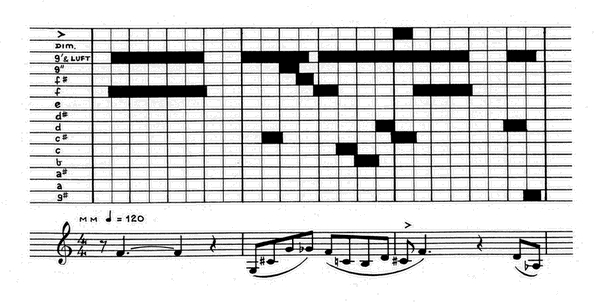
How the machine interprets a music roll.
The lowest 12 tracks operate the keys of the flute, the next one up opens and closes the air supply and the two upper tracks are spare. In the score above one of these two spare tracks is used to put a stress on a note. When the machine is playing a duet these two spare tracks are used to send cues to the live player - two LEDs on the music stand. The example is taken from Afternoon Loop by Hartmut Westphal (1980).
Notice the small extensions at the beginnings and ends of the marks relative to the next track above. I found that these were neccesary to achieve a clean transition between notes. I suppose a live player must do this intuitively.
The Reversibles (1983)
In 1983 Tom Johnson was a guest of the German Academic Exchange Programme (DAAD) in Berlin. He spent most of his three-month
stay drawing his Reversibles. Each strip is played forwards and backwards, then turned over and again played forwards and backwards, thus providing 4 unique melody lines. This project marked the start of many years of collaboration between us.
Lesley Olson plays All Change at the Philharmonie in Essen, Germany (2013).
Several composers have written for the machine. Works include All Change (photo) by Schaun Tozer (1982), a twelve minute flute duet for machine and live player; and Zure Study by Suguru Goto (1995) which explores the transition from order to randomness and back again. Also a flute duet by Phillip Corner (1983) where 20-second-long strips were selected and successively fed into the machine by an operator (me) to provide an Alberti bass while Eberhard Blum improvised a treble line.



 Écoutez par les Yeux, Musée d'Art Moderne de la Ville de Paris (1980)

 Lesley Olson plays All Change at the Philharmonie in Essen, Germany (2013).